
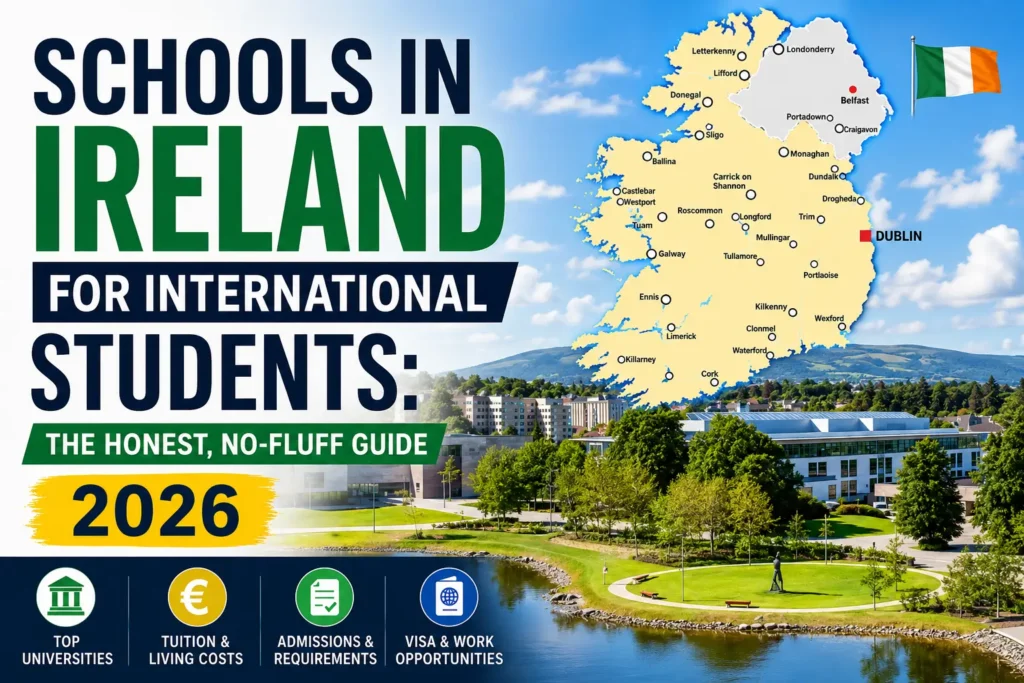
Discover the best schools in Ireland for international students in 2026. Compare universities, tuition fees, scholarships, visas, costs, and admissions.
Last updated: August 2026 • Reading time: approximately 18 minutes
Let’s get straight to it, because I know why you’re here.
You’ve probably typed “schools in Ireland for international students” into Google at 1am, half-excited and half-panicking about tuition fees. So here’s the short version, then we’ll go deep.
Yes, schools in Ireland for international students are genuinely good — English-speaking, safe, home to Google and Meta’s European HQs, and with post-study work permission (up to 24 months for master’s graduates) that beats many competing destinations.
No, it’s not free for everyone (that “study in Ireland for free for international students” search you did? We’ll get to it). And yes, some schools in Ireland for international students are surprisingly affordable, while others will empty your savings account in one semester.
There’s no single “best” school. There’s a best school for you — for your budget, your grades, your career plans. That’s what this guide is actually for.
This guide is for:
- ✔ Undergraduate applicants
- ✔ Master’s applicants
- ✔ Students looking for scholarships
- ✔ Students searching for schools without IELTS
- ✔ Budget-conscious applicants comparing tuition and living costs
- ✔ Students weighing Dublin against other Irish cities
Ireland at a Glance (2026 Highlights)
- 👉 Ireland has over 30 universities and higher education institutions that accept international students, from ancient research universities to applied technological universities.
- 👉 Tuition fees for schools in Ireland for international students typically range from €9,000 to €45,000+ per year, depending on level and course.
- 👉 Many schools accept Duolingo, PTE, TOEFL, or an MOI letter instead of IELTS.
- 👉 Technological universities are usually the cheapest route through Irish higher education.
- 👉 Scholarships are available through the Irish government and individual universities — but they’re competitive and often have earlier deadlines than admission itself.
- 👉 Students can work 20 hours a week during term, full-time during holidays, and stay up to two years after graduation to look for work.
What You’ll Learn
- 👉 Why study in Ireland
- 👉 Tuition fees
- 👉 Cost of living
- 👉 Studying for free / scholarships
- 👉 Student visa
- 👉 Who should look elsewhere
- 👉 Schools without IELTS
- 👉 Undergraduate admission
- 👉 Master’s admission
- 👉 Trinity College Dublin requirements
- 👉 Top 10 schools
- 👉 Cheapest universities
- 👉 Private schools
- 👉 Vocational schools
- 👉 Common mistakes
- 👉 FAQs
Pros and Cons of schools in Ireland for international students at a Glance
| Pros | Cons |
|---|---|
| English-speaking, no language barrier | Dublin rent is genuinely expensive |
| Up to 24 months post-study work permission | Scholarships are competitive and deadline-sensitive |
| Strong, internationally recognised universities | Limited dependent/family visa options for students |
| Real scholarship opportunities | Accommodation can be hard to secure before arrival |
| Access to European HQs of major tech companies | Mandatory health insurance adds to upfront costs |
Why Study in Ireland? (The Real Reasons, Not the Brochure Ones)
Every prospectus tells you Ireland has “world-class education.” True, but vague. Here’s what actually matters on the ground.
It’s English-speaking. Sounds obvious, but it means your degree, your part-time job, and your social life all happen in the language you’re studying in. No adjusting to lectures in a second language on top of everything else.
The work permission is generous. International students can work 20 hours a week during term and full-time during holidays. After graduation, non-EU students get stay-back permission under the Third Level Graduate Programme (Stamp 1G) — 12 months for an honours bachelor’s degree, up to 24 months for a master’s or PhD — to look for work, no job offer required to apply.
Big tech is genuinely there. Companies such as Google, Meta, LinkedIn, Stripe, and TikTok have major European operations based in Dublin, not just a sales office. If you’re studying tech, business, or data science, that’s not marketing spin, that’s real access to internships and grad jobs.
It’s small. Ireland has a population of about 5 million. That means class sizes at most schools in Ireland for international students are manageable, and it’s genuinely possible to get face time with professors — something that’s much harder at a 40,000-student mega-university elsewhere.
Here’s the part nobody puts in the brochure, though: Dublin is expensive. For many international students, accommodation costs become one of the biggest financial challenges of the whole degree. If nobody tells you that upfront, you find out the hard way in October when your accommodation budget doesn’t stretch to December. We’ll cover exactly how to plan around this.
Is Ireland Good for International Students? Honestly — Yes, With Conditions
💡 Quick Answer
Yes. Ireland is one of Europe’s stronger study destinations for international students because it offers English-taught programmes, internationally recognised universities and schools in Ireland for international students, part-time work rights, real scholarship opportunities, and generous post-study work permission. The biggest downside is the cost of living, especially in Dublin — that’s the part that catches people out.
We’ll be straight with you: Ireland is good for international students who do their homework before they arrive, and rough for the ones who don’t.
The students who thrive are the ones who picked a city outside Dublin, applied for scholarships early, and had a realistic budget. The students who struggle almost always made the same mistake — they picked the most famous name (usually Trinity College Dublin) without checking the actual cost of living in that city, and without applying anywhere else as a backup.
One mistake many students make: they assume “Ireland” means “Dublin.” It doesn’t. Cork, Galway, Limerick, and Maynooth are all real options with lower rent and genuinely good schools in Ireland for international students— and from what we’ve seen, some students end up preferring them.
Tuition Fees: What Schools in Ireland for International Students Actually Cost
This is the number everyone actually wants, so here it is straight, no padding.
| Level | Typical Fee Range (Non-EU, per year) | Notes |
|---|---|---|
| Undergraduate (general) | €9,850 – €25,000 | Business and humanities sit at the lower end |
| Undergraduate (engineering/tech) | €20,000 – €30,000 | Lab and equipment costs push this up |
| Undergraduate (medicine) | €42,500 – €65,000+ | Genuinely one of the most expensive routes in Europe |
| Master’s (taught) | €10,000 – €35,000 | Business, data science, and healthcare are the priciest |
| Master’s (research) | €5,000 – €20,000 | Often cheaper than taught programmes |
A few honest notes on this table. First, these are tuition fees only — living costs are separate, and we’ll get to those next. Second, “cheap” is relative. If someone tells you they found a school in Ireland for international students charging €4,000 a year for a real, accredited undergraduate degree, be skeptical and check accreditation carefully before you pay anything.
If you’re looking specifically for cheap universities in Ireland for international students, the honest answer is: technological universities (formerly called Institutes of Technology) are consistently cheaper than the older, more famous universities. Places like TU Dublin, Munster Technological University (MTU), and Atlantic Technological University (ATU) often charge non-EU undergraduate fees in the €9,000–€14,000 range, which is genuinely on the lower end for schools in Ireland for international students.
✅ Bottom Line
If your total budget is under €15,000 a year, don’t anchor your search on Dublin’s biggest names — start with technological universities and regional campuses instead.
Cost of Living: The Part That Actually Breaks Budgets
If your budget is tight, this section matters more than the tuition table above.
| City | Monthly Living Costs (approx.) | Vibe |
|---|---|---|
| Dublin | €1,600 – €2,200+ | Career opportunities, but rent is brutal |
| Cork | €1,100 – €1,500 | Second city, much calmer rent market |
| Galway | €1,000 – €1,400 | Smaller, student-friendly, arts scene |
| Limerick | €1,000 – €1,300 | Good value, growing tech sector |
| Maynooth | €900 – €1,300 | Commutable to Dublin, cheaper base |
In reality, if you’re coming from a country where €1,000 a month sounds like a lot, wait until you see a one-bedroom listing in Dublin. Accommodation is the single biggest line item, and it’s the one students underestimate the most. Budget for it first, then work backward to figure out which city and which school actually fits.
Bottom line: Pick your city based on rent before you pick your university based on name — the wrong city can cost you more than the wrong course.
Can International Students Study in Ireland for Free?
Let’s be real about this one, because it gets searched a lot and the honest answer disappoints people.
Full free tuition in Ireland is really reserved for EU/EEA/Swiss students under the “Free Fees Initiative” — and even then, they still pay a student contribution charge (currently around €2,500–€3,000 a year). If you’re a non-EU international student, “study in Ireland for free” isn’t realistic as a starting assumption.
What is realistic: scholarships that cover a big chunk of tuition, sometimes close to full cost, especially for strong master’s applicants. That’s a very different thing from “free,” but it’s the honest path that actually exists. If you’re still weighing countries against each other, it’s also worth comparing Ireland with other affordable study destinations in Europe before you commit.
Scholarships: Ireland Universities for International Students
Here’s where we’ve seen students leave money on the table simply because they didn’t apply — scholarships in Ireland aren’t automatic, and a lot of them have surprisingly early deadlines.
| Scholarship | Level | Value | Who It’s For |
|---|---|---|---|
| Government of Ireland International Education Scholarship | Master’s/PhD | Up to €10,000 + fee waiver | High-achieving students, competitive |
| Trinity International Scholarship | Undergraduate/Masters | Partial to full fee reduction | Trinity-specific, merit-based |
| UCD Global Excellence Scholarship | Undergraduate | Partial tuition reduction | UCD applicants with strong grades |
| University of Galway International Scholarship | Undergrad/Masters | €1,000 – €5,000 | Broad eligibility, worth applying |
| Maynooth University International Scholarship | Undergrad/Masters | Partial tuition reduction | Good option, less competitive than Trinity/UCD |
🎓 Expert Tip
If you’re looking for scholarships, apply the moment applications open — not after you’ve been accepted. Most Irish universities process scholarships alongside admissions, not after, and the good ones run out.
Student Visa: What You Actually Need
If you’re a non-EU/EEA student staying longer than 90 days, you’ll need a “D” study visa before travel, then register for an Irish Residence Permit (IRP) once you land. Budget roughly €75 for the visa application and about €300 for the IRP registration fee.
Immigration also wants to see that you can actually afford to be there — currently proof of at least €10,000 for living costs on top of your first year’s tuition being paid or secured. This is exactly why the cost-of-living table above matters: undershoot it and your visa application gets flagged.
If English tests scare you, here’s some good news for the visa side specifically: Ireland’s immigration service accepts several English tests, not just IELTS — more on that next.
Who Should Choose Ireland (And Who Shouldn’t)
Choose Ireland if:
- ✔ You want an English-taught degree with strong post-study work rights
- ✔ You’re targeting a career in tech, finance, or a field with a big Dublin presence
- ✔ You’re willing to research scholarships and apply early
- ✔ You’re open to studying outside Dublin to keep costs manageable
Don’t choose Ireland if:
- ✘ Your budget genuinely can’t stretch past tuition — living costs will catch you out
- ✘ You need a country with widely available dependent/family visas for students
- ✘ You’re set on studying in a specific big city and Dublin rent is a dealbreaker with no fallback plan
- ✘ You haven’t budgeted for health insurance and upfront visa/registration costs
Who Should Probably Look at Another Country?
Ireland isn’t the right fit for everyone, and it’s worth saying so plainly. You might want to compare other destinations first if:
- 👉 Your entire annual budget, tuition and living costs combined, is genuinely below €12,000 — Ireland can work at the low end of tuition, but total cost is harder to hit at that level than in some other countries
- 👉 You need guaranteed dependent or family visa options alongside your student visa
- 👉 You want the lowest possible cost of living in Europe — Germany and parts of continental Europe are generally cheaper on that specific measure
- 👉 You don’t want to compete for accommodation — Ireland’s student housing shortage, especially in Dublin, is real and worth factoring in before you commit
None of this means Ireland is a bad choice. It means it’s the right choice for a specific kind of student, and it’s worth being honest about who that is before you apply.
How Ireland Compares to Other Study Destinations
A rough, high-level comparison — treat these as ballpark figures to guide your research, not exact numbers, since they shift year to year and by institution.
| Country | Typical Annual Tuition (Non-EU/International) | Post-Study Work Visa | Notable Trade-off |
|---|---|---|---|
| Ireland | €9,000 – €45,000+ | Up to 24 months (master’s/PhD), 12 months (bachelor’s) | Dublin rent is high; not in the Schengen Area |
| UK | £22,000 – £38,000 | 18–24 months depending on when you graduate | Generally higher tuition than Ireland |
| Canada | CA$20,000 – $35,000 | Up to 3 years, with a clearer path to permanent residency | Higher living costs in major cities |
| Germany | €0 – €3,000 (public) or higher at private ones | Around 18 months | Many postgrad programmes require German language ability |
| Australia | AU$30,000 – $45,000 | 2–4 years depending on qualification | High tuition and living costs overall |
If permanent residency is your main long-term goal, Canada and Germany are generally considered stronger paths. If you want the shortest route from enrolment to working legally with minimal language barriers, Ireland’s one-year master’s plus 24-month stay-back is hard to match.
Schools in Ireland for International Students Without IELTS
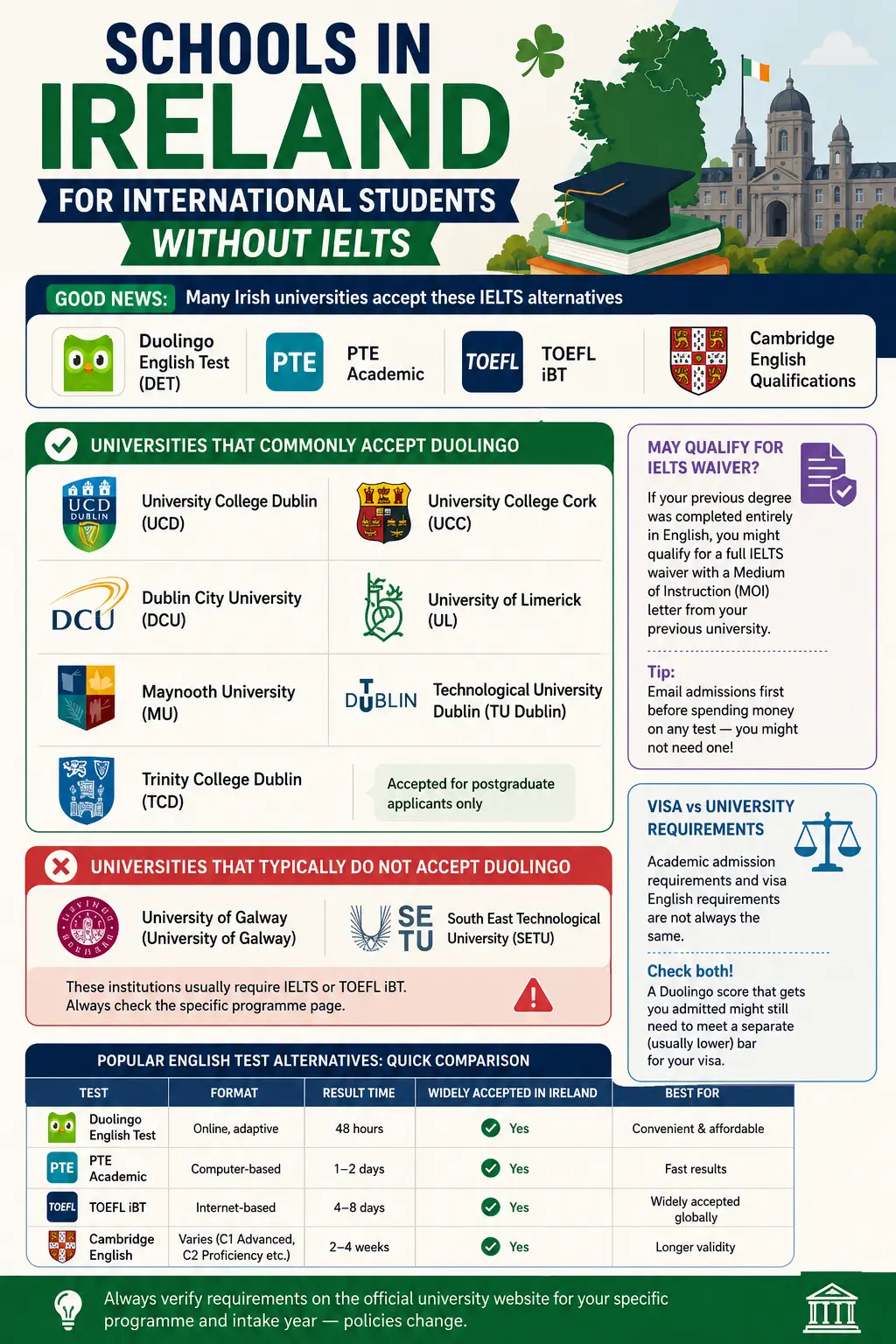
This is one of the most searched long-tail terms around this topic, and for good reason — IELTS is expensive, slow, and stressful for a lot of applicants.
The good news: a growing number of universities in Ireland now accept the Duolingo English Test (DET) as an alternative, along with PTE Academic, TOEFL iBT, and Cambridge English qualifications. Universities that commonly accept Duolingo include UCD, UCC, DCU, University of Limerick, Maynooth University, TU Dublin, and — for postgraduate applicants specifically — Trinity College Dublin. A few institutions, including University of Galway and SETU, still require IELTS or TOEFL rather than Duolingo, so always check the specific programme page.
If you completed your previous degree entirely in English, you might also qualify for a full IELTS waiver using a Medium of Instruction (MOI) letter from your old school. It’s worth emailing admissions before you spend money on any test — sometimes you don’t need one at all. If IELTS alternatives are new territory for you, it’s worth reading up on IELTS alternatives generally before picking a test, since acceptance varies just as much between countries as it does between Irish universities.
One honest caveat: passing the university’s English requirement and passing the visa’s English requirement aren’t always the same threshold. A Duolingo score that gets you admitted academically might still need to clear a separate (usually lower) bar for the visa itself. Don’t assume — check both.
Undergraduate Admission: Ireland Universities for International Students Undergraduate
If you’re applying for undergraduate study, most Irish universities want:
- ✔ Completed secondary school (WAEC, A-Levels, IB, or equivalent, depending on your country)
- ✔ A personal statement or letter of motivation
- ✔ English proficiency proof (IELTS, TOEFL, PTE, or Duolingo, or a waiver)
- ✔ Sometimes a portfolio or interview, for creative or medical programmes
If your WAEC result is strong, you’re in a genuinely good position — Irish universities are used to evaluating WAEC and generally have clear conversion tables for it, especially universities that already have a track record with Nigerian applicants.
Master’s Admission: Schools in Ireland for International Students Master’s
For a master’s degree, requirements typically include a relevant bachelor’s degree (usually a 2:1 equivalent or above for competitive programmes), a CV, references, a statement of purpose, and English proficiency proof.
📌 Did You Know?
Irish master’s programmes are often just one year, not two. That’s a real cost advantage — one year of tuition and living costs instead of two — which is part of why Ireland has become such a popular master’s destination lately.
Trinity College Dublin Requirements for International Students

Trinity gets searched constantly, so let’s actually talk about it honestly instead of just repeating “Ireland’s oldest and most prestigious university” like every other page does.
Trinity College Dublin requirements for international students generally include: strong academic transcripts (Trinity is genuinely competitive, especially for popular courses like law, medicine, and computer science), English proficiency (IELTS 6.5+ or equivalent, DET accepted for many postgraduate courses), a personal statement, and — for undergraduate applicants outside the EU — an application through Trinity’s own international application portal rather than the standard Irish CAO system.
⚠️ Important
Many students apply only to Trinity College Dublin first simply because it’s the name they’ve heard of, without checking that undergraduate non-EU fees there often sit well above €20,000 a year for many courses, before living costs. That’s not a criticism of Trinity — it’s an excellent university — but if your budget is limited, this may not be your best first choice, and it shouldn’t be your only application.
Trinity College Dublin — quick take:
- 👉 Pros: Global reputation, strong alumni network, central Dublin location, genuinely excellent research output
- 👉 Cons: High fees, competitive admission, Dublin’s cost of living stacked on top
- 👉 Best for: Strong academic applicants who can genuinely afford Dublin, or who secure a scholarship
- 👉 Who should avoid it: Budget-conscious students without funding secured — there are better value options below
Quick Comparison: Best School by Category
If you just want the short version before you read the full breakdown:
| Best For | University |
|---|---|
| Lowest tuition | TU Dublin |
| Best overall reputation | Trinity College Dublin |
| Cheapest cost of living | Maynooth University |
| Best scholarships | UCD |
| Best technology courses | Dublin City University (DCU) |
| Best engineering | University of Limerick |
Top 10 Schools in Ireland for International Students
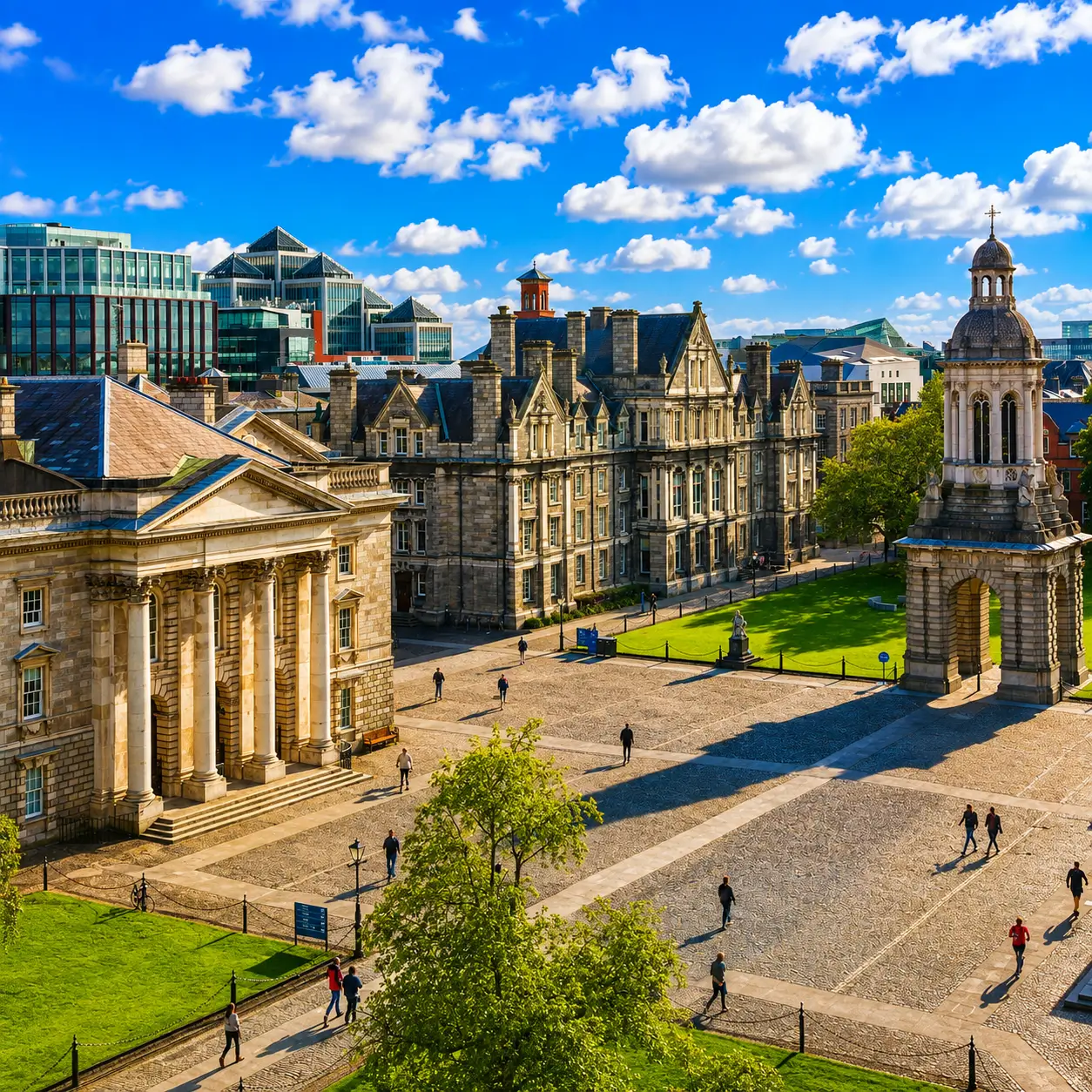
How we put this list together: these schools in Ireland for international students were compared on tuition fees, academic reputation, scholarship availability, graduate employability, acceptance of international applicants, cost of living in their city, and post-study work opportunities — not just name recognition.
Here’s an honest comparison, not a copy-pasted ranking list.
| University | Known For | Approx. Non-EU UG Fees | Best For |
|---|---|---|---|
| Trinity College Dublin | Prestige, law, medicine, research | €20,000 – €45,000+ | Strong students who can afford Dublin |
| University College Dublin (UCD) | Business, tech, largest university | €18,000 – €35,000 | Career networking, tech-adjacent fields |
| University of Galway | Arts, marine science, medicine | €15,000 – €30,000 | Students who want a smaller-city feel with big-name research |
| Dublin City University (DCU) | Business, journalism, tech links | €14,000 – €25,000 | Students who want Dublin without full Trinity/UCD price tags |
| University College Cork (UCC) | Sciences, food science, medicine | €14,000 – €28,000 | Budget-conscious students who still want a big university |
| University of Limerick | Sport science, engineering, business | €13,000 – €24,000 | Engineering and sport-related courses |
| Maynooth University | Computer science, arts, growing reputation | €12,000 – €20,000 | Best value near Dublin without Dublin prices |
| TU Dublin | Applied, vocational-leaning tech degrees | €9,000 – €18,000 | Practical, career-focused courses on a budget |
| Munster Technological University (MTU) | Engineering, business, applied sciences | €9,500 – €17,000 | Cheapest genuine university-level option |
| South East Technological University (SETU) | Business, engineering, applied arts | €9,500 – €16,000 | Affordable regional option |
A quick honest note on Maynooth University, since it comes up a lot in searches: it’s often underrated. It’s about 25 minutes from Dublin by train, so you still get access to internships and city life, but rent is noticeably cheaper than living in Dublin itself. For computer science and arts programmes especially, it’s one of the better value schools in Ireland for international students right now.
Here’s a closer look at how the major ones actually compare, beyond the table.
Trinity College Dublin. If prestige is your priority, Trinity is hard to beat — the name is recognised by employers worldwide, and the alumni network is genuinely strong. The downside is cost: both tuition and Dublin accommodation can stretch a budget fast. Best for strong applicants who can afford Dublin or who land a scholarship.
University College Dublin (UCD). Ireland’s largest schools in Ireland for international students, with heavy business and tech links thanks to its proximity to Dublin’s corporate hubs. Good scholarship programme, but non-EU fees are still on the higher end. Best for students prioritising networking and career pipelines over saving money.
University of Galway. A smaller-city feel with genuinely strong research output, especially in medicine and marine science. Living costs are noticeably friendlier than Dublin. Worth noting it currently requires IELTS or TOEFL rather than Duolingo — check this before you commit to a test.
Dublin City University (DCU). Strong for business, journalism, and tech-adjacent programmes, with fees that sit below Trinity and UCD while still being in the capital. A reasonable middle ground if you want Dublin without the top-tier price tag.
University College Cork (UCC). A large, well-regarded schools in Ireland for international students with strong sciences and medicine, in a noticeably cheaper city than Dublin. Good option if you want a big-university feel without big-city rent.
University of Limerick. Known for sport science, engineering, and business, with a campus-based feel and moderate living costs. Best for students specifically targeting engineering or sport-related fields.
Maynooth University. Covered above — strong computer science and arts programmes, close enough to Dublin for opportunities, cheap enough to actually afford. Consistently one of the better value schools in Ireland for international students.
TU Dublin, MTU, SETU. The technological universities. Less globally famous, more career-and-skills focused, and consistently the cheapest genuine university-level route into Ireland. If tuition is your main constraint, start here rather than working down from Trinity.
✅ Bottom Line
There’s no universally “best” university or schools in Ireland for international students on this list — only the best fit for your budget, your course, and how much you value a famous name versus lower stress about money.
Cheapest Universities in Ireland for International Students
If tuition is your main constraint, here’s the straight list — no glossy language, just numbers.
| University | Approx. Cheapest UG Fee | Trade-off |
|---|---|---|
| MTU | ~€9,500/year | Regional location (Cork area) |
| TU Dublin | ~€9,000/year | Dublin location, but Dublin rent still applies |
| SETU | ~€9,500/year | Less globally known name |
| ATU | ~€9,800/year | Smaller international student community |
| Maynooth University | ~€12,000/year | Slightly pricier, but strong value overall |
If you simply want the absolute lowest tuition number, technological universities alias tech schools in Ireland for international students win every time. If you want low tuition and manageable rent, look at ATU’s regional campuses or MTU in Cork — you get both wins at once, which is honestly the smartest combination if your budget is genuinely tight.
Private Schools in Ireland for International Students
Private colleges are a different category entirely, and it’s worth understanding why someone would choose one.
Private schools in Ireland for international students — places like Griffith College, National College of Ireland (NCI), and Dublin Business School (DBS) — often have smaller class sizes, more flexible entry requirements (some genuinely easier IELTS waivers), and multiple intakes per year instead of just September. They’re a solid option if your grades don’t quite meet a public university’s cutoff, or if you missed the main application window.
The trade-off: tuition is often comparable to or higher than public universities, and the research reputation and global name recognition usually isn’t as strong. If prestige and research output matter for your career plans, a public university is usually the better call. If flexibility and a faster route to studying in Ireland matter more, private colleges are worth serious consideration.
Vocational Schools in Ireland for International Students
Not every good outcome in Ireland requires a university degree, and this route gets overlooked more than it should.
Vocational schools in Ireland for international students, typically Post Leaving Certificate (PLC) colleges and Education and Training Boards (ETBs), offer diplomas and certificates in areas like hospitality, culinary arts, IT support, healthcare assisting, and business administration. Fees are generally much lower than university tuition, often in the €4,000–€9,000 range, and courses are shorter — usually one to two years.
If you want a faster, cheaper route into the Irish job market, or you’re planning to use a vocational qualification as a stepping stone toward further study, this path deserves more attention than it usually gets in these guides.
Application Process and Documents Needed
Here’s the checklist, stripped down to what actually matters:
- 1.Academic transcripts and certificates (WAEC, A-Levels, bachelor’s degree, etc.)
- 2.English proficiency proof (IELTS, TOEFL, PTE, Duolingo, or MOI waiver)
- 3.Passport copy
- 4.Personal statement or statement of purpose
- 5.Reference letters (usually two, especially for postgraduate applications)
- 6.CV or resume (mainly for master’s applicants)
- 7.Proof of funds (for the visa stage, not admission)
- 8.Application fee payment (varies by university, usually €35–€75)
Deadlines Worth Knowing
Most schools in Ireland for international students run a September intake as the main one, with applications opening around October–November the year before and closing anywhere from January to June depending on the course and your nationality. A smaller January intake exists at some universities, mainly for postgraduate courses.
⚠️ Important
If you’re applying for a scholarship, treat the scholarship deadline as your real deadline — it’s often earlier than the general admission deadline, and missing it usually means missing the funding entirely, even if you still get admitted.
Part-Time Jobs and Work Opportunities
If you want to work while you “study in Ireland for free for international students”, non-EU students on a student visa can work 20 hours a week during term time and up to 40 hours during official college holidays. Common student jobs include retail, hospitality, and campus roles, and Dublin’s tech scene also opens up part-time and internship opportunities for students in relevant fields.
After graduation, the Third Level Graduate Programme gives most bachelor’s and master’s graduates 12–24 months to stay in Ireland and look for work, depending on your qualification level. This is genuinely one of Ireland’s strongest selling points compared to some other study destinations.
10 Mistakes International Students Make When Applying to Schools in Ireland
Looking through admission requirements and fee schedules across dozens of schools in Ireland for international students, the same mistakes keep showing up:
- 1.Applying only to Trinity College and nowhere else
- 2.Ignoring accommodation costs until after they’ve accepted an offer
- 3.Applying for scholarships after the deadline instead of alongside admission
- 4.Assuming every private schools in Ireland for international students waives IELTS without checking the specific programme
- 5.Underestimating how long visa processing actually takes
- 6.Choosing a course by name recognition instead of career prospects
- 7.Overlooking regional universities and technological universities entirely
- 8.Forgetting to budget for mandatory health insurance
- 9.Waiting until after arrival to start looking for accommodation
- 10.Not double-checking programme-specific admission requirements before applying
Most of these aren’t dramatic mistakes — they’re just the boring admin stuff that gets skipped in the excitement of getting an offer letter. Skipping this list is usually what turns “study in Ireland for free for international students” from exciting into stressful.
One More Quick Decision Guide
| If you want… | Consider… |
|---|---|
| Lowest tuition | MTU, TU Dublin, SETU |
| Highest prestige | Trinity College Dublin |
| Best scholarships | UCD |
| Lower living costs | Maynooth, Galway, Limerick |
| Technology courses | DCU, UCD |
| Engineering | University of Limerick |
| Nursing | Trinity, DCU, University of Galway |
FAQs: Schools in Ireland for International Students
1. Which are the cheapest universities in Ireland for international students?
Technological universities like MTU, TU Dublin, SETU, and ATU generally offer the lowest tuition, often starting around €9,000–€10,000 a year for undergraduate courses.
2. Can I study in Ireland without IELTS?
Yes. Many schools in Ireland for international students accept Duolingo, PTE, TOEFL, or an MOI waiver instead of IELTS, though requirements vary by university and programme.
3. What are the Trinity College Dublin requirements for international students?
Strong academic transcripts, English proficiency proof, a personal statement, and application through Trinity’s international portal for non-EU undergraduates.
4. Can international students study in Ireland for free?
Not typically. Free tuition mainly applies to EU/EEA/Swiss students. Non-EU students should look at scholarships instead, which can cover a large portion of fees.
5. Which vocational schools in Ireland accept international students?
vocational schools in Ireland for international students like PLC colleges and ETB-run institutions across the country accept international students for diplomas in hospitality, IT, healthcare assisting, and business.
6. Is Ireland good for international students?
Generally yes — English-speaking, safe, strong post-study work rights — but it requires careful budgeting, especially around Dublin rent.
7. What are private schools in Ireland for international students like?
private schools in Ireland for international students have Smaller classes, more flexible entry requirements, multiple intakes, but usually less global prestige than public universities.
8. What’s the cheapest university in Ireland for a master’s degree?
Technological schools in Ireland for international students and some regional campuses of ATU and MTU tend to have the lowest master’s tuition, often under €12,000 a year.
9. Do I need IELTS for a master’s degree in Ireland?
Not always — many master’s programmes accept Duolingo, PTE, or TOEFL as alternatives.
10. What GPA do I need for Irish universities as an international student?
It varies by university and course, but a 2:1 equivalent (roughly a B average) is a common benchmark for competitive master’s programmes.
11. How much does it cost to live in Dublin as a student?
Typically €1,600–€2,200+ a month, mostly driven by rent.
12. Is Cork cheaper than Dublin for international students?
Yes, noticeably — often €400–€700 less per month in living costs.
13. What is Maynooth University known for?
Strong computer science and arts programmes, and its location close to Dublin at a lower cost of living.
14. Are there scholarships specifically for Nigerian students in Ireland?
Most scholarships aren’t nationality-specific, but the Government of Ireland scholarship and individual university scholarships are open to Nigerian applicants who meet the criteria.
15. How long is a master’s degree in Ireland?
Usually one year for taught master’s programmes, which is shorter (and cheaper overall) than many other countries.
16. Can I bring my family with me as an international student in Ireland?
Generally not on a standard student visa — dependent visas for students are limited, so check current immigration rules carefully before assuming this is possible.
17. What is the average processing time for an Irish student visa?
Typically 4–8 weeks, though it can vary by embassy and time of year, so apply early.
18. Do schools in Ireland for international students accept WAEC results?
Yes, most Irish universities have conversion tables for WAEC and are experienced in evaluating Nigerian applicants.
19. What’s the difference between a university and a technological university in Ireland?
Technological universities tend to be more career/applied-focused with lower fees; traditional universities lean more research-focused with higher global name recognition.
20. Can I work full-time as an international student in Ireland?
Only during official college holidays. During term time, it’s capped at 20 hours a week.
21. What English score do I need for Trinity College Dublin?
Generally IELTS 6.5 or higher (or equivalent on another accepted test), though it varies by specific course.
22. Is UCD or Trinity better for international students?
Neither is objectively “better” — Trinity has slightly more prestige, UCD is larger with strong business and tech links. Choose based on your course and budget, not name recognition alone.
23. What documents do I need for an Irish student visa?
Passport, proof of acceptance from your university, proof of funds, proof of tuition payment (or scholarship), and English proficiency proof.
24. How much money do I need to show for an Irish student visa?
Roughly €10,000 in accessible funds for the first six months, on top of proof your first-year tuition is covered.
25. Are there any schools in Ireland for international students with rolling admissions?
Some private colleges like Griffith College and DBS offer multiple intakes throughout the year, which functions similarly to rolling admissions.
26. Can I study in Ireland with WAEC only?
For undergraduate entry, yes — many Irish universities accept WAEC results on their own, provided grades meet the course’s specific subject and grade requirements.
27. How much bank balance is required for an Irish student visa?
You generally need to show at least €10,000 in accessible funds for living costs, on top of proof that your first year’s tuition is paid or secured.
28. Can I study nursing in Ireland as an international student?
Yes — schools in Ireland for international students including Trinity College Dublin, University of Galway, University of Limerick, and Dublin City University offer NMBI-approved nursing degrees, though English requirements are often higher than average (commonly IELTS 6.5–7.0) and not every nursing programme accepts non-EU applicants, so check each course page carefully.
29. Which universities accept HND or a second-class lower degree for a master’s?
Some schools in Ireland for international students, including National College of Ireland (NCI) and a number of technological universities, consider HND holders and second- or third-class degree holders for master’s entry, often weighing relevant work experience alongside academic results.
30. Is Ireland cheaper than Canada for international students?
It depends heavily on the city and course, but Irish tuition and living costs are broadly comparable to mid-range Canadian cities, while Dublin specifically tends to run more expensive than most Canadian cities outside Toronto and Vancouver.
31. Which courses are in high demand for international students in Ireland?
Data science, computer science, nursing, engineering, business analytics, and pharmacy consistently attract strong interest, partly because they align with Ireland’s Critical Skills Employment Permit list.
32. Which city is cheapest for students in Ireland?
Among the main student cities, Maynooth, Limerick, and Galway tend to offer the lowest overall living costs, with Dublin consistently the most expensive.
33. Do all schools in Ireland for international students require health insurance for international students?
Yes — non-EU students are generally required to hold private health insurance for the duration of their visa, and it’s worth budgeting for this separately from tuition and living costs.
34. Can I switch universities after starting a course in Ireland?
It’s possible but not simple — it typically requires a new application, updated visa registration, and approval from both institutions, so it’s better to choose carefully upfront than to plan on switching.
35. Do schools in Ireland for international students offer pre-sessional English courses?
Yes, several universities offer pre-sessional or foundation English courses for students who are close to but not quite meeting the required English score.
36. What’s the difference between CAO and direct university applications for international students?
CAO (Central Applications Office) handles most undergraduate applications for EU students and some non-EU applicants, while many non-EU undergraduate applicants — especially at universities like Trinity — apply directly through the university’s own international portal instead.
37. Is accommodation guaranteed for international students in Ireland?
Not automatically — university accommodation is often limited and competitive, so applying for housing the moment you receive your offer matters more in Ireland than in many other study destinations.
Before You Apply: A Quick Checklist
- ✔ Compare tuition fees across at least 4–5 universities, not just the famous one
- ✔ Calculate real living costs for your target city, not just Dublin averages
- ✔ Apply for scholarships early — treat that deadline as your real deadline
- ✔ Confirm your English language requirement for both admission and the visa
- ✔ Prepare visa documents and proof of funds well ahead of the deadline
- ✔ Start looking for accommodation the moment you receive your offer
Final, Honest Take
If we were choosing today, here’s how we’d think about it: figure out your real budget first — tuition plus living costs, not just tuition — and then pick your city before you pick your university’s name. A great degree at Maynooth or MTU with manageable rent will serve you better than a prestigious name in Dublin that leaves you stressed about food money every month.
Ireland genuinely delivers on the things that matter — the English-language environment, the work rights, the access to global companies. Just go in with your eyes open about the cost, apply for scholarships early, and don’t assume the most famous school is automatically the right one for you.
Figure out your real budget first — tuition plus living costs, not just tuition — then pick your city before you pick your university’s name. A great degree at Maynooth or MTU with manageable rent will serve you better than a prestigious name in Dublin that leaves you stressed about food money every month.
Official Resources
- 👉 Irish Immigration Service (irishimmigration.ie) — visas, IRP registration, English language requirements for study visas
- 👉 Education in Ireland (educationinireland.com) — the official government portal for studying in Ireland as an international student
- 👉 Central Applications Office (cao.ie) — undergraduate applications for Irish higher education institutions
- 👉 Individual university admissions pages (Trinity, UCD, and others) for course-specific and up-to-date fee and requirement details
This guide on schools in Ireland for international students was researched using official Irish university admissions pages, Education in Ireland resources, and Irish immigration guidance current as of publication. Tuition fees, scholarship details, and visa requirements change year to year — always confirm current figures with the relevant institution or government source before applying.
Related reading you might find useful: Ireland student visa guide, cheapest countries to study abroad, scholarships in Europe for international students, IELTS alternatives explained, cost of studying in Europe compared by country, Ireland’s graduate work permit after study, student accommodation in Ireland, and part-time jobs for students in Ireland.
[ez-toc]